
Hamilton Incyte Arc Viable Cell Density Sensor
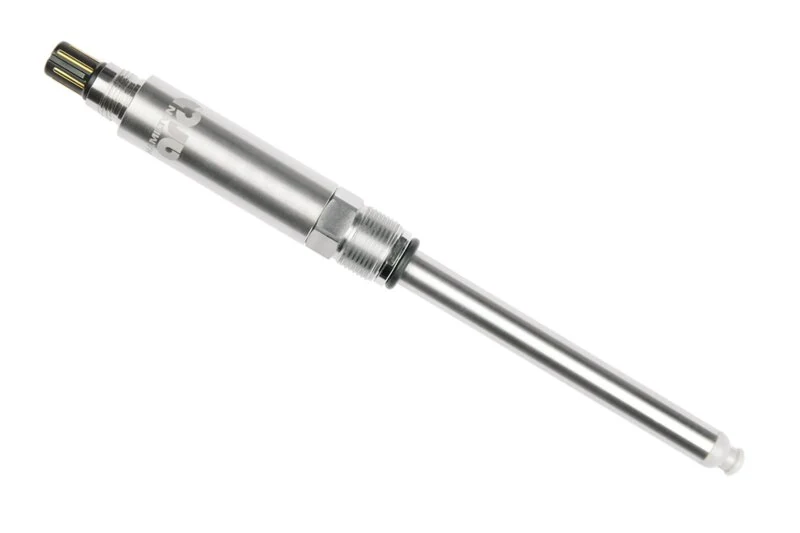
Real-time viable cell density (VCD) monitoring by permittivity measurement, without off-line sampling: the Hamilton Incyte Arc is a digital Arc sensor that is autoclavable and compatible with CIP and SIP, for bioreactors and fermenters.
Send us your requirementHamilton Incyte Arc Viable Cell Density Sensor — describe your application and we will help you identify the right model and configuration together.
Technical specifications
| Measurement principle | Capacitive permittivity measurement (dielectric spectroscopy) |
|---|---|
| Measured parameter | Viable cell density (VCD) |
| Measuring range | Animal cells: 5 x 10^5 to 8 x 10^9 cells/mL; bacteria and yeast: 5 to 200 g/L; permittivity: 0 to 700 pF/cm |
| Conductivity range | 0.5 to 80 mS/cm |
| Process temperature and pressure | 0 to 60 °C; 0 to 12 bar |
| Sterilization and cleaning | Autoclavable, CIP and SIP |
| Sensing element and connection | Platinum electrodes; PG 13.5 stainless steel process connection; VP8 connector with integrated micro-transmitter |
| Output | Arc digital (Modbus); an Arc Wi 2G Adapter BT (REF 243470) provides an analog 4-20 mA signal |
| Shaft lengths | Incyte Arc Expert: 120 mm (REF 243950-0211), 220 mm (-0212), 320 mm (-0213) and 420 mm (-0214) |
The Hamilton Incyte Arc monitors viable cell density (VCD) in real time by permittivity (dielectric spectroscopy) measurement. It removes the waiting time of off-line sampling, carries an integrated micro-transmitter with Arc digital output, and is autoclavable and compatible with CIP and SIP. As one of Hamilton’s distributors in Turkey, Mikron Proses (Üsküdar, Istanbul) supplies Incyte Arc sensors and provides application consulting on sensor selection and ArcAir integration.
Need viable cell density monitoring for a bioreactor? → Send us your requirement
For the comparison with the optical Dencytee sensor and the single-use InCyte line, see the InCyte and Dencytee cell density sensors page.
Why permittivity?
Permittivity measurement detects only viable cells with an intact cell membrane. Dead cells, cell debris and microcarriers do not contribute to the permittivity measurement, which gives an independent measurement of viable cell density within a culture and is not influenced by media composition. Permittivity is directly proportional to viable cell biovolume, which correlates to viable cell density in many applications. The sensor performs in many mammalian, insect, bacterial and fungal systems, depending on the cell concentration at inoculation.
Measuring ranges
| Measurement parameter | Measurement range |
|---|---|
| Permittivity | 0 to 700 pF/cm |
| Animal cells | 5 x 10^5 to 8 x 10^9 cells/mL |
| Bacteria and yeast | 5 to 200 g/L |
The sensor scans permittivity at 17 different frequencies between 0.3 and 10 MHz. Configuration and calibration are done in ArcAir; see the Arc peripherals and ArcAir page. Other bioreactor sensors on the same platform include the GlucoSense glucose sensor, the CO2NTROL dissolved CO2 sensor and the EasyFerm Plus pH sensors.
Which shaft length fits your bioreactor depends on the port and the immersion depth. Tell us about your bioreactor and we will help you select the right model.
Applications
- Viable cell density monitoring in monoclonal antibody (mAb) production in biopharma
- Optimization of CHO, HEK293 and hybridoma cell cultures
- Growth curve tracking in fermentation processes
- Real-time cell counting in perfusion bioreactors
Other Hamilton products
- Hamilton Arc Peripherals and ArcAir Software (Arc View Mobile, Arc Wi Pivot, Arc USB, ArcAir) Online Measurement and Automation Systems
- Hamilton ChemoTrode pH Sensors for Aggressive Media pH and ORP Sensors
- Hamilton CO2NTROL Solid-State Optical Dissolved CO2 Sensor Online Measurement and Automation Systems
- Hamilton DuraCal pH Buffer, ORP and Conductivity Calibration Solutions Online Measurement and Automation Systems
- Hamilton EasyControl pH and ORP Sensors pH and ORP Sensors
- Hamilton Bioprocess pH Sensors (EasyFerm Plus, EasyFerm Bio and OneFerm) pH and ORP Sensors
- Hamilton GlucoSense In-Situ Optical Glucose Sensor for Bioreactors Online Measurement and Automation Systems
- Hamilton Cell Density Sensors (InCyte / Dencytee) Online Measurement and Automation Systems
- Hamilton Conductivity Sensors Conductivity Sensors
- Hamilton InchTrode pH Electrode pH and ORP Sensors
- Hamilton IonoTrode pH Electrode for Low-Conductivity Media pH and ORP Sensors
- Hamilton Calibration Solutions (DuraCal pH and ORP Buffers and Conductivity Standards) Online Measurement and Automation Systems
- Hamilton Laboratory pH and ORP Electrodes (GLP Series) Online Measurement and Automation Systems
- Hamilton Process Analytics, Liquid Handling and Laboratory Solutions Online Measurement and Automation Systems
- Hamilton Microlab 600 and 700 Diluters, Dispensers and Syringe Pumps Online Measurement and Automation Systems
- Hamilton MecoTrode pH Electrode Hamilton pH and ORP Process Sensors
- Hamilton OEM Sensors and Sensor Accessories Online Measurement and Automation Systems
- Hamilton Oxygen Sensor Accessories (Oxylyte Electrolyte, Membrane Kits, Calibration Station) Hamilton Dissolved Oxygen Sensors
- Hamilton OneFerm pH Single-Use pH Sensor Hamilton pH and ORP Process Sensors
- Hamilton Polilyte Plus pH Sensors Hamilton pH and ORP Process Sensors
- Hamilton Process Fittings and Flow Cells (FlexiFit, StatoFlex, FlowChamber, FlowCell, FlexiFlow, MasterFit) Online Measurement and Automation Systems
- Hamilton Retractex Retractable Sensor Housings Online Measurement and Automation Systems
- Hamilton Precision Syringes, Needles and Chromatography Accessories Online Measurement and Automation Systems
- Hamilton VisiFerm DO, OxyFerm, OxyGold and Oxysens Dissolved Oxygen Sensors Hamilton Dissolved Oxygen Sensors
Send us your requirement for Hamilton Incyte Arc Viable Cell Density Sensor
Describe your application; we will help you identify the right model and configuration.